#2 First Floor Dukheri Road, Mohra District Ambala 133004
support@curasiamedilabs.com
+91-9316815270, 9499164371, 7988871718
#2 First Floor Dukheri Road, Mohra District Ambala 133004
support@curasiamedilabs.com
+91-9316815270, 9499164371, 7988871718

September 29, 2026
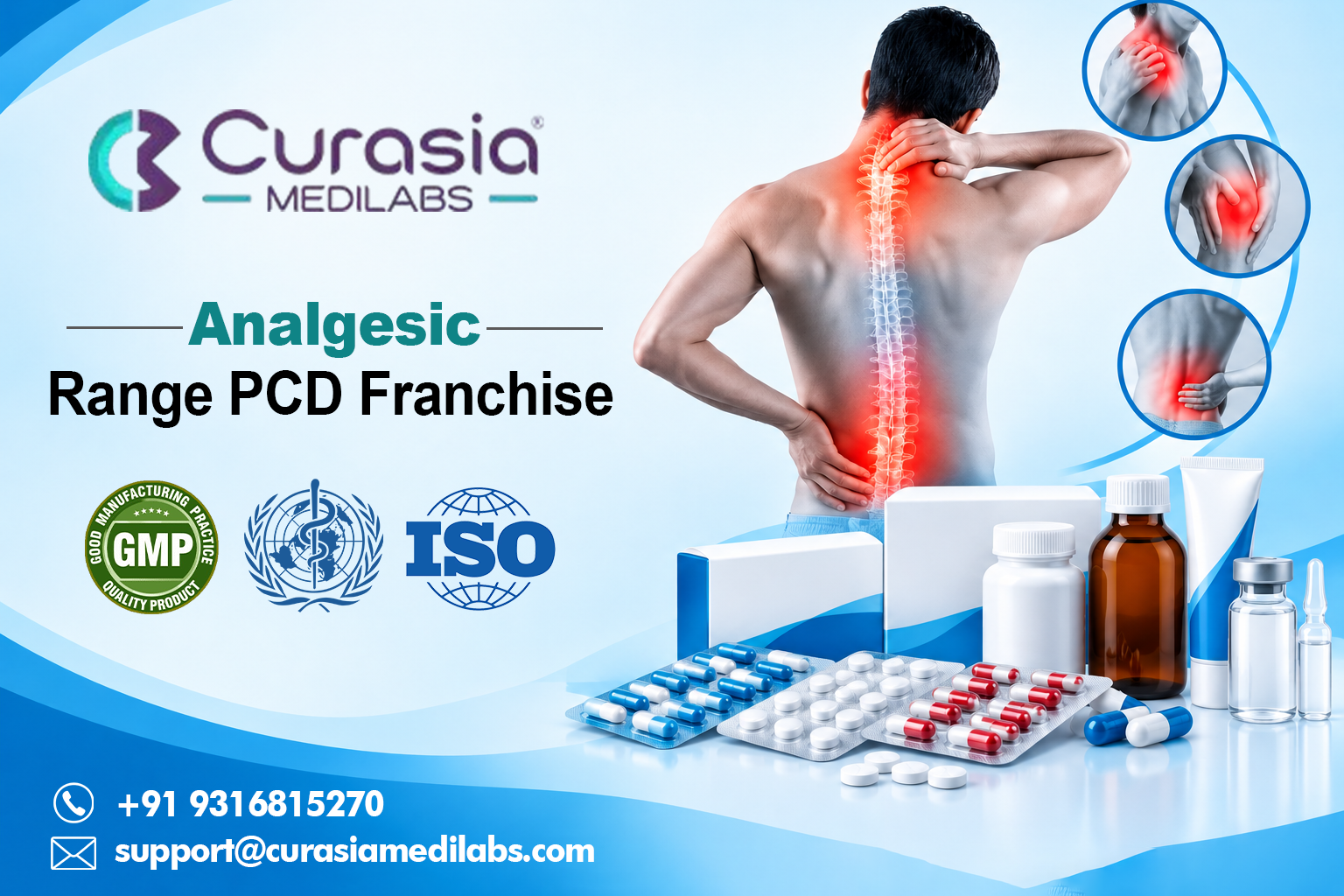
Pain is the one complaint that sends people to a doctor or a chemist in every season, in every age group, in every district. Back pain from long desk hours, joint pain in older patients, muscle strain after physical work, post-operative discomfort, headaches, dental pain — the list is long and none of it depends on the weather. That constant demand is what makes an Analgesic Range PCD Franchise one of the most dependable business bets in pharma distribution, and also one of the easiest to get wrong if the product range behind it is thin.
The mistake most new partners make is treating analgesics as a single category. In practice, patients and prescribers reach for very different formats depending on what hurts and how badly.
Oral tablets handle the bulk of everyday prescriptions — anti-inflammatory and muscle relaxant combinations for musculoskeletal pain, and higher-strength options like etoricoxib for arthritis and inflammatory conditions. Topical gels and sprays cover localised pain, which matters because many patients, especially older ones and those with stomach sensitivity, actively prefer applying something to the skin over swallowing another tablet. Injectables serve acute pain in clinic and hospital settings where fast relief matters. Paediatric suspensions handle fever and pain in children, where a tablet simply isn’t an option. And combination formulations pair a pain reliever with a muscle relaxant or a nerve-support ingredient for conditions where one active ingredient isn’t enough.
The gastric-safety angle deserves its own mention. Long-term or repeated use of oral anti-inflammatory painkillers is a well-known cause of stomach irritation, so doctors increasingly look for alternatives or pair the prescription with acid protection. That’s one reason topical formats have grown in importance — they let a prescriber offer pain relief to patients who can’t comfortably tolerate another oral NSAID, and a franchise partner stocking those alternatives becomes the obvious supplier for exactly those patients.
An Analgesic Range PCD Franchise partner who carries only tablets is effectively turning away four out of these five customer groups before the conversation even starts.
Most people picture an orthopaedic surgeon when they think of pain medication. The reality is that analgesics get prescribed by almost every kind of clinician — general physicians, orthopaedists, dentists, paediatricians, gynaecologists managing menstrual pain, and surgeons handling post-operative care.
That breadth is a genuine advantage for an Analgesic Range PCD Franchise partner, because it means you’re not dependent on winning over one narrow specialist group. It also means a range that only suits one type of prescriber leaves money on the table. A dentist wants something different from a paediatrician, and neither wants exactly what an orthopaedist writes for arthritis.
There’s a further wrinkle worth planning around. Prescribers rarely switch pain-relief brands casually, because they’ve seen how specific formulations perform with their own patients — a doctor who’s had good results with a particular etoricoxib combination will keep writing it until something gives them a reason to change. That makes the first impression with a new prescriber matter more here than in most categories: consistent stock, reliable batch quality, and clear composition information tend to win a doctor’s loyalty far more effectively than aggressive discounting ever does.
Before signing with any manufacturer, verify their licensing status directly through India’s Central Drugs Standard Control Organisation rather than trusting a franchise brochure at face value.
Curasia Medilabs produces a dedicated Analgesic and Muscle Relaxant range covering most of those formats. On the tablet side, this includes Etorsia 90 (Etoricoxib 90 mg) for pain and inflammation in conditions like rheumatoid arthritis, and Etorsia-T4, which combines Etoricoxib with Thiocolchicoside as a pain reliever plus muscle relaxant. For topical use, there’s Diclik Gel, a Diclofenac-based formulation blended with linseed oil, methyl salicylate, and menthol, and Diclik Spray for acute musculoskeletal pain. Injectable needs are covered by Diclik Injection, and paediatric patients are served by Thermostat-M2, a Mefenamic Acid plus Paracetamol suspension. Everything is manufactured in WHO-GMP certified facilities, and the wider catalogue is on the product page, with the pain-relief tablets and gels listed under the orthopedic products section.
The injectable side has its own dedicated write-up on the Diclofenac Sodium Injection page for anyone who wants detail on that specific product.
A few practical points matter more than the product names when judging an Analgesic Range PCD Franchise partnership:
Format coverage. Tablets, gel, spray, injection, and paediatric suspension under one company means one supplier relationship covering nearly every pain-related prescription a clinic writes.
Written territory rights. Monopoly protection through the monopoly-based franchise model should spell out district or headquarter boundaries in the agreement, not rely on verbal assurance.
A broader catalogue to fall back on. The company’s range extends into General Medicine, Neuropsychiatry through Curasia Neurocare, and Gynecology, so a partner isn’t tied to a single category if local demand shifts.
Regional operating experience. Curasia Medilabs already runs franchise operations across Punjab, Haryana, Himachal Pradesh, and Jammu & Kashmir, giving practical familiarity with how pain-management prescriptions move through North Indian clinics and pharmacies.
Check territory availability first for your Analgesic Range PCD Franchise on the PCD Pharma Franchise page — in a high-demand category like this, popular districts get claimed quickly and there’s no point negotiating terms for an area that’s already assigned.
Standard paperwork applies: Drug License (retail or wholesale), GST registration, Aadhar and PAN card, and a registered business address for billing. Most companies also ask for an advance order or security deposit before the first dispatch.
Read the agreement closely, focusing on the territory exclusivity clause and the minimum order quantity, since these two terms decide how protected your market really is and how much working capital you’ll need locked in stock. If bulk production suits you better than distribution, third-party manufacturing is a separate route worth looking at.
Wider trends across India’s pharmaceutical sector, including high-volume categories like pain management, are tracked by industry bodies such as IBEF. For territory-specific questions, the contact page is the quickest route to a direct answer.
Pain management doesn’t follow trends or seasons, which is exactly why it stays one of the steadiest categories in Indian pharma. The partners who do well aren’t the ones with a single popular tablet, but the ones who can supply the right format for each patient and prescriber walking through the door. A serious Analgesic Range PCD Franchise should cover tablets, topicals, injectables, and paediatric options, back them with WHO-GMP certification, and put monopoly terms in writing. Curasia Medilabs meets those requirements while offering a broader multi-category catalogue, which makes it a practical starting point for anyone building a long-term franchise business around pain management.
An Analgesic Range PCD Franchise typically covers pain-relief tablets, muscle relaxant combinations, topical gels and sprays, injectables, and paediatric suspensions distributed within an assigned territory.
Many patients, particularly older ones or those with stomach sensitivity, prefer applying a gel or spray directly to the affected area instead of taking another oral tablet.
General physicians, orthopaedists, dentists, paediatricians, gynaecologists, and surgeons all prescribe pain relievers regularly, which makes the prescriber base far wider than most people expect.
Check the company’s registration status directly through India’s Central Drugs Standard Control Organisation rather than relying only on brochure claims.
A Drug License, GST registration, Aadhar and PAN card, a registered business address, and an advance order or security deposit as required by the company.
October 16, 2026


 Open Product List
Leave a Reply