#2 First Floor Dukheri Road, Mohra District Ambala 133004
support@curasiamedilabs.com
+91-9316815270, 9499164371, 7988871718
#2 First Floor Dukheri Road, Mohra District Ambala 133004
support@curasiamedilabs.com
+91-9316815270, 9499164371, 7988871718

September 19, 2026
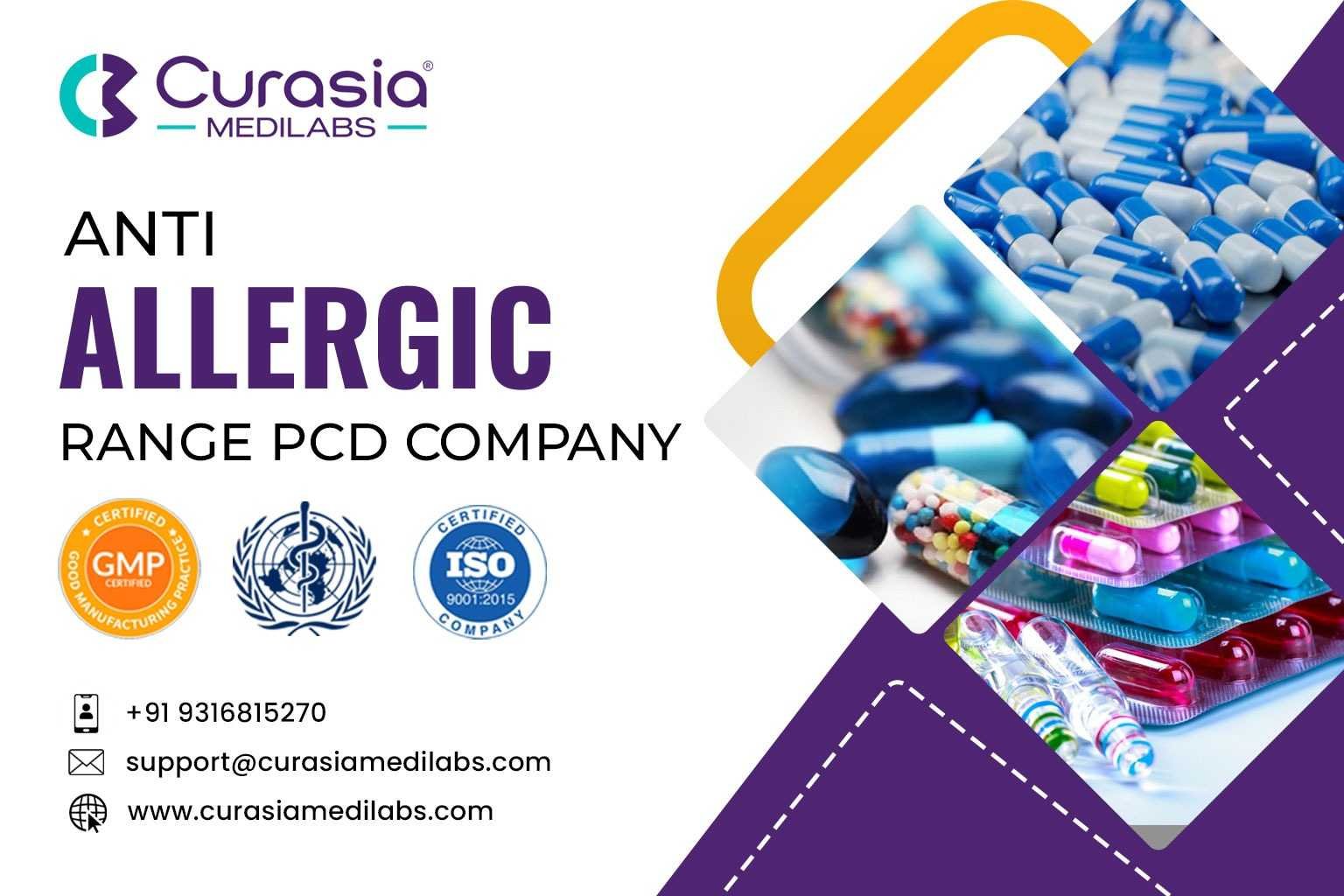
Allergies don’t really have an off-season in India anymore. Pollution spikes trigger respiratory allergies in cities year-round, seasonal pollen still causes the usual spring and monsoon flare-ups, and skin allergies from food, weather changes, and contact irritants keep general physicians and dermatologists busy every month of the calendar. That constant, overlapping demand is exactly why partnering with the right Anti Allergic Range PCD Company has become one of the steadier bets in pharma franchise business right now.
Most pharma categories have a clear peak and trough. Cold and flu medicines spike in winter. Anti-allergic products don’t follow that same clean pattern, because allergic triggers themselves are so varied — dust and pollution cause year-round respiratory symptoms, seasonal pollen adds a spring bump, food and contact allergies show up unpredictably, and skin allergies from changing weather add yet another layer on top. The result is a category where some sub-segment is almost always active somewhere in the country.
This matters practically for a franchise partner. A single-product antihistamine line only catches part of this demand. A genuinely wide Anti Allergic Range PCD Company portfolio — covering oral antihistamines, anti-allergic syrups for children, topical creams for skin reactions, and combination formulations for respiratory allergies — lets a partner serve whichever sub-segment is flaring up locally at any given time, rather than depending on one narrow product doing all the work.
New entrants to this segment tend to focus entirely on the antihistamine tablet and forget the rest of what an Anti Allergic Range PCD Company should actually cover. That’s a mistake, because anti-allergic demand splits across several distinct product formats that different patients need.
Pediatric patients need syrups, not tablets — a franchise partner without a child-friendly formulation loses every pediatrician account by default. Skin allergy patients need topical creams and ointments, which is a completely separate shelf from oral medication and often gets overlooked by manufacturers who think of “anti-allergic” purely as a tablet category. And chronic allergic rhinitis patients frequently need combination therapy — antihistamine plus a nasal decongestant or steroid spray — which a narrow product line simply can’t supply.
There’s a seasonal timing element worth planning around too. Respiratory allergy complaints tend to spike during Delhi-NCR and North Indian winter smog, dust storms in the pre-monsoon months, and pollen counts in early spring, while skin allergy consultations often rise during the hot, humid stretch before monsoon arrives. A franchise partner stocking a genuinely wide range doesn’t need to guess which product to push each month — the local season effectively decides it, and having the right format already in stock means not losing a sale to a competitor who happened to carry it.
Checking whether a manufacturer’s licensing actually holds up is worth doing before signing anything. India’s Central Drugs Standard Control Organisation lets you verify a company’s registration status directly rather than relying on what’s printed in a franchise brochure.
Curasia Medilabs manufactures Anti-Allergic formulations as one of its core categories, alongside General Analgesics, Antibiotics, Injectables, PPIs, Hematinics, and Anti-Cold products. All formulations are produced in WHO-GMP certified facilities, giving franchise partners a consistent, quality-controlled product to build a reputation around rather than one where batch variation becomes a recurring complaint. The broader catalogue sits on the product page, covering tablets, syrups, capsules, and combination formulations across therapy areas.
A few things separate a genuinely useful Anti Allergic Range PCD Company partnership from a token one:
Format variety over a single tablet. Being able to offer syrups for pediatric patients and topical formulations for skin allergies alongside standard antihistamine tablets means covering three separate prescriber relationships instead of one.
Territory that’s actually protected. Monopoly rights through the monopoly-based franchise structure are defined district-wise or headquarter-wise in the agreement itself, rather than left as a verbal understanding that can shift later.
A catalogue that extends beyond one category. Anti-allergic patients often need general medicine too, and Curasia Medilabs’ broader range — including Neuropsychiatry through its Curasia Neurocare division, Gynecology, and Orthopedic products — means a single franchise partner can service a much wider slice of a clinic’s prescriptions.
Regional familiarity. The company already operates across Punjab, Haryana, Himachal Pradesh, and Jammu & Kashmir, which translates into practical knowledge of how allergic conditions actually present and get treated in North Indian markets rather than generic national assumptions. Winter smog in the Punjab-Haryana belt and dust exposure across agricultural regions both shape which anti-allergic formulations move fastest locally, and a manufacturer that already understands this doesn’t need a franchise partner to explain it from scratch.
Eligibility and territory availability are worth checking first with any Anti Allergic Range PCD Company, through the PCD Pharma Franchise page — there’s no point negotiating terms for a district that’s already assigned to someone else.
Documentation needed is fairly standard across this industry: a Drug License (retail or wholesale), GST registration, Aadhar and PAN card, and a registered business address for billing purposes. Most companies also expect a security deposit or an advance order before dispatch begins.
Read the franchise agreement itself carefully before signing, particularly the territory exclusivity clause and the minimum order quantity — these two terms determine how protected your market actually is and how much working capital you’ll need to keep tied up in stock. For anyone considering bulk production instead of distribution, third-party manufacturing is worth exploring as a separate route.
India’s broader pharmaceutical manufacturing landscape, including growth in specialty categories like anti-allergic formulations, continues to be tracked by industry bodies such as IBEF. For territory-specific questions, the contact page is the quickest way to get a direct answer.
Anti-allergic products occupy an unusual position in pharma — genuine, near-constant demand without the clean seasonal pattern that makes most categories easy to plan around. That makes format variety and territory protection more important here than in almost any other segment. A dependable Anti Allergic Range PCD Company should offer more than a single antihistamine tablet, back it with WHO-GMP certification, and put monopoly terms in writing rather than a verbal promise. Curasia Medilabs covers those requirements while also supplying a broader multi-category range, making it a practical option for anyone building a long-term franchise business around this segment.
An Anti Allergic Range PCD Company supplies branded antihistamine tablets, syrups, and topical formulations for franchise partners to distribute within an assigned territory, usually on a monopoly basis.
Allergic triggers vary widely — pollution causes year-round respiratory symptoms, pollen adds seasonal spikes, and skin and food allergies appear unpredictably — so demand stays fairly constant rather than peaking at one time of year.
Oral tablets for adults, syrups for pediatric patients, and topical creams for skin allergies are the three main formats a genuinely wide anti-allergic range should include.
Check the company’s registration status directly through India’s Central Drugs Standard Control Organisation rather than relying solely on brochure claims.
A Drug License, GST registration, Aadhar and PAN card, a registered business address, and an advance order or security deposit as required by the company.
October 16, 2026


 Open Product List
Leave a Reply